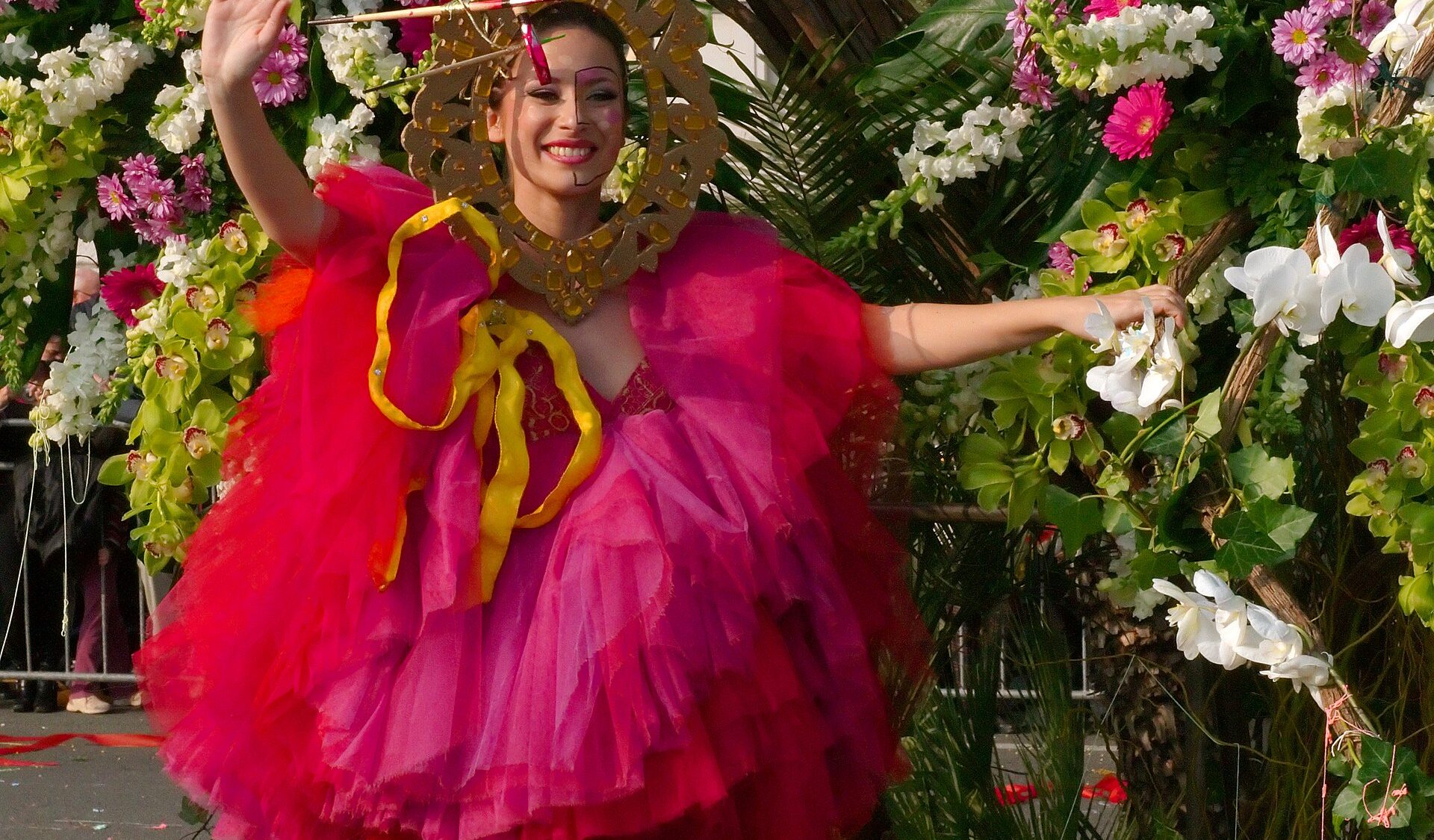
Nice in February gives you a full-scale carnival with the Mediterranean as its backdrop: giant floats lit up on Place Masséna at night, and flower-covered floats throwing mimosa into the crowd along the seafront by day. Pick the right weekend and you can see both on one Saturday, then spend Sunday in the Old Town and up Castle Hill. It suits couples, families and anyone who wants their carnival with winter sun.
Why go
The organisers call it France’s first carnival with an international character, and its modern form dates back to 1873, when a carnival committee was set up to draw winter visitors to the Riviera. Three years later, in 1876, the first Battle of Flowers took place on the Promenade des Anglais. Both traditions still anchor the programme.
What sets Nice apart from Venice or Cologne is the mix: night parades of giant floats, daytime processions dressed in fresh flowers, and a seaside resort in between. The organisers say 80% of the flowers are grown locally, and florists spend 72 hours dressing each float in the Halle Spada before every Battle of Flowers.
Nice
Don’t miss
The places that make the trip, and why each one deserves your time.

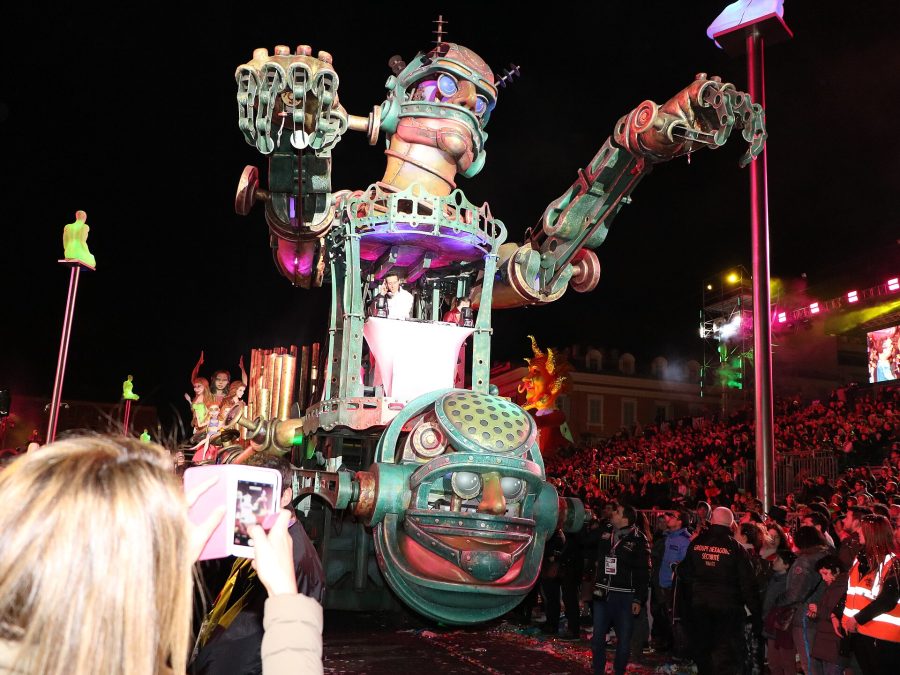
JEAN-PIERRE PROUTEAU / Wikimedia Commons, CC BY-SA 4.0 Place Masséna
The red-ochre square between the old and new towns is the carnival's stage, where the illuminated parades roll past giant floats and the King and Queen make their entrance.
Arrive two hours early; gates open then.
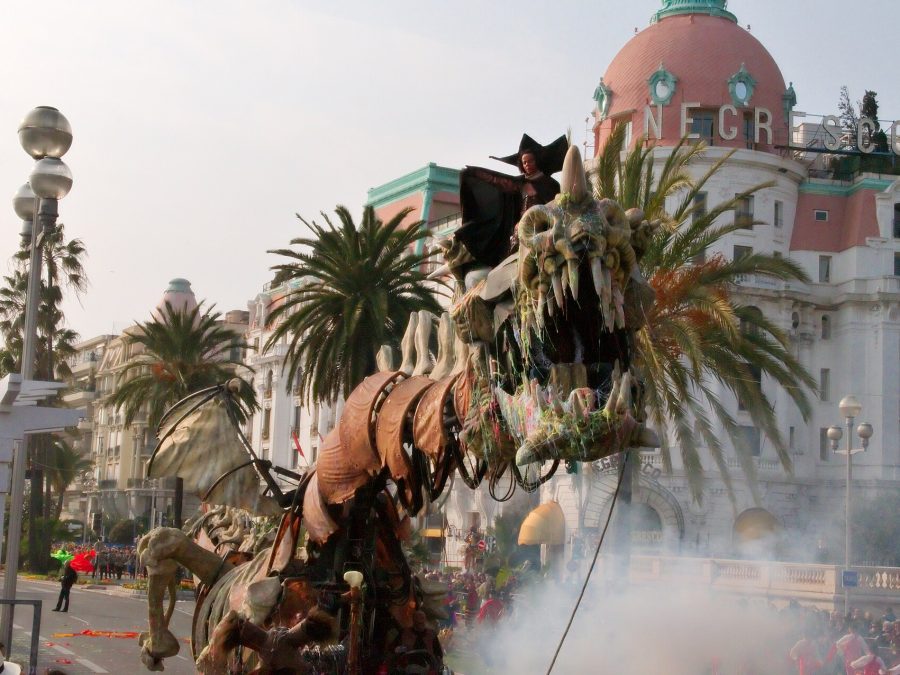
Zil / Wikimedia Commons, CC BY-SA 3.0 Battle of Flowers
Costumed riders on about fifteen flower-covered floats throw mimosa, gerberas and lilies into the crowd, a tradition first staged on the Promenade des Anglais in 1876.
Leftover flowers are handed out at the end.
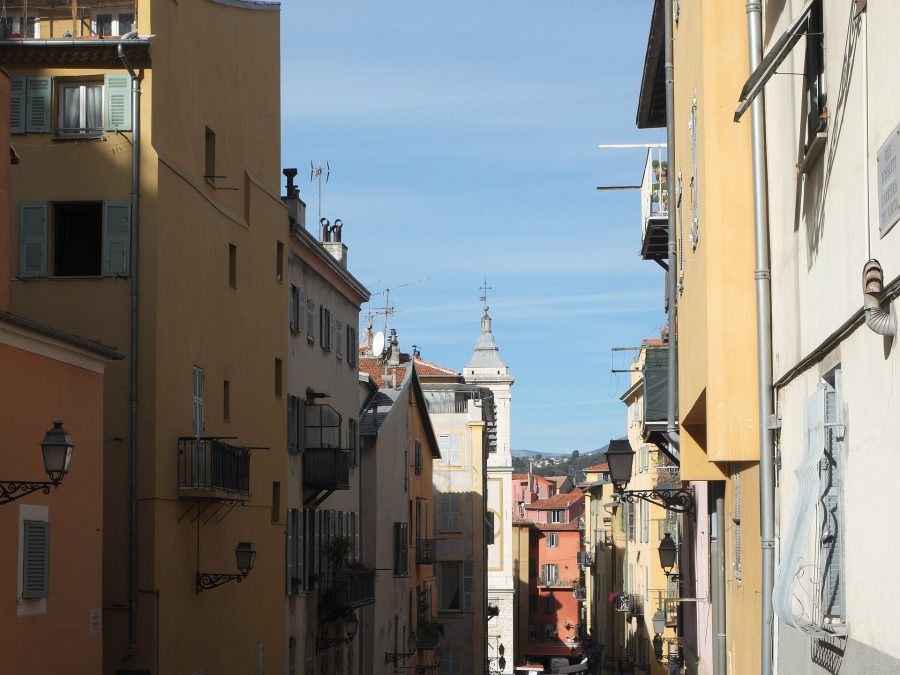
GFreihalter / Wikimedia Commons, CC BY-SA 4.0 Vieux Nice
A tangle of narrow lanes in ochre and pink under the castle hill, where washing hangs between shutters and socca comes hot from the oven.
Watch the waiters' race here on Sunday 14 February.
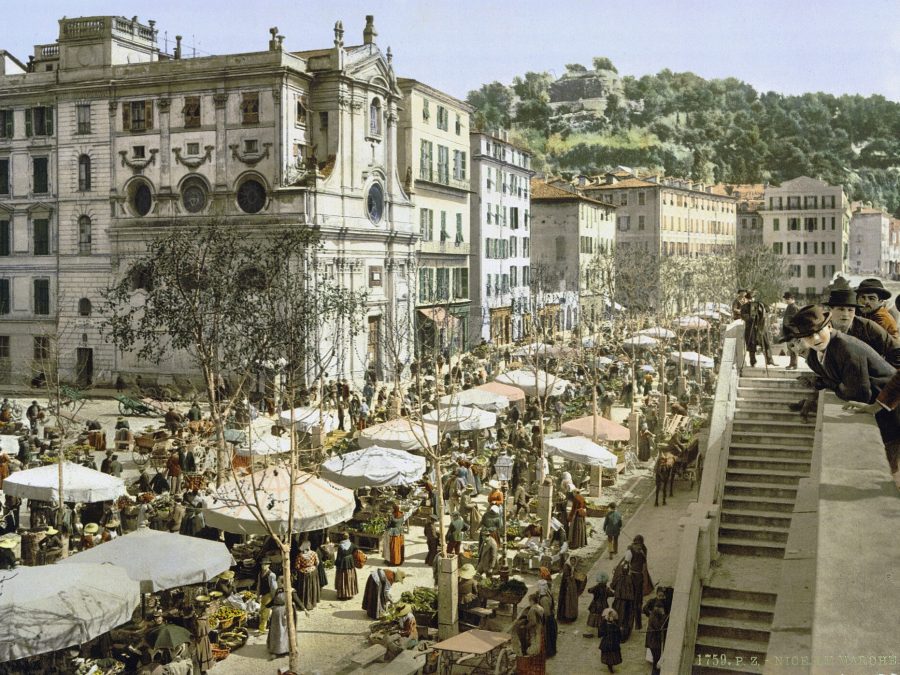
Unknown authorUnknown author / Wikimedia Commons, Public domain Cours Saleya
The Old Town's long market square, filled with flower and produce stalls and café terraces, and the street where carnival floats paraded in the 19th century.
Flower market Tuesday to Sunday; antiques on Mondays.
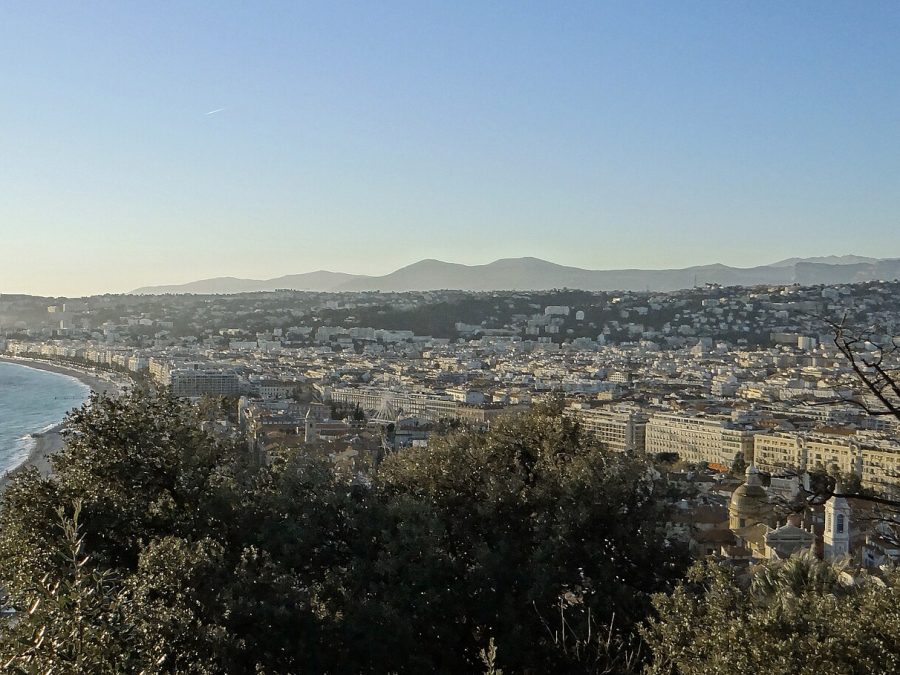
Jacques MOSSOT / Wikimedia Commons, CC BY-SA 4.0 Castle Hill
A park on the site of the castle Louis XIV's troops destroyed in 1706, with an artificial waterfall and a panorama over the Old Town and the Baie des Anges.
Take the lift up from the Old Town.
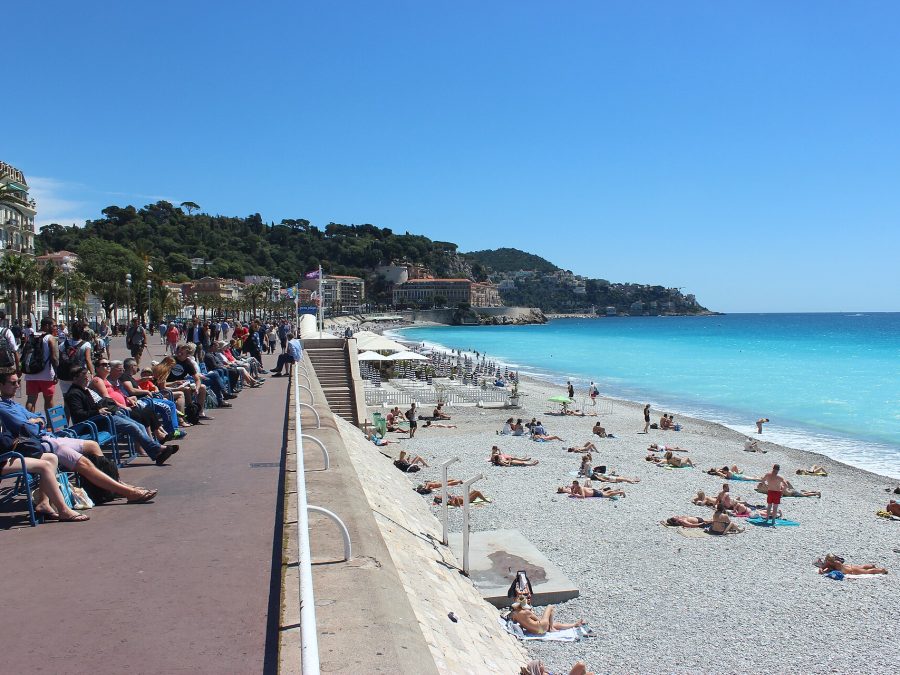
Uhooep / Wikimedia Commons, CC BY-SA 4.0 Promenade des Anglais
The seafront promenade curving around the Baie des Anges carries the flower battles, and on the last night it hosts the burning of the carnival king and fireworks.
The king burns at 10.45pm on 27 February.
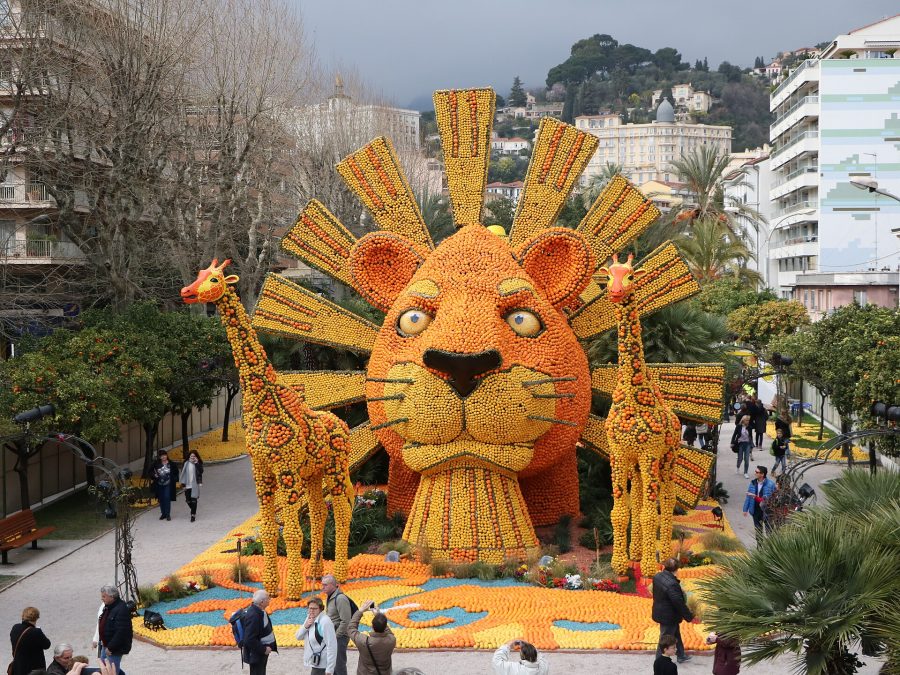
PROUTEAU JEAN-PIERRE / Wikimedia Commons, CC BY-SA 4.0 Menton Lemon Festival
The pastel town near the Italian border turns oranges and lemons into floats and giant sculptures for its Fête du Citron, themed Douce France in 2027.
Runs 13 to 28 February 2027.
Nice Carnival 2027: dates and programme
The official carnival site gives the dates as Tuesday 9 to Sunday 28 February 2027, under the theme "Vive l’Amour". The organisers announce 56 events in total, 45 of them free, and say the programme may still change.
The main parades on the official programme:
- Illuminated parades (corsi carnavalesques illuminés), Place Masséna: the opening parade on Saturday 13 February at 9pm, then Tuesday 16, Saturday 20 and Tuesday 23 February at 8.30pm, and the closing parade on Saturday 27 February at 8.30pm.
- Battles of Flowers (batailles de fleurs), from Place Masséna: Wednesday 17, Saturday 20, Wednesday 24 and Saturday 27 February, all at 2.30pm.
- Corso carnavalesque d’Aqui: Sunday 21 February at 2.30pm on Place Masséna, the daytime parade at the heart of a day given over to Niçois traditions.
- Burning of the king and fireworks: Saturday 27 February at 10.45pm on the Promenade des Anglais, the traditional finale.
Other dates worth knowing: a free Mardi Gras celebration on 9 February, the Grand Charivari at the Maison de Carnaval on 10 February, and on Friday 12 February the free opening celebration, the arrival of the King and Queen on Place Masséna and the opening of the Carnival Village from 7pm. The Village then opens daily from 11am to 7pm, later on parade evenings. Lou Queernaval, on Friday 26 February at 8pm on Place Masséna, is free but needs a reservation.
What the parades are
- The illuminated corso: The classic carnival parade, with giant floats, oversized heads and street performers, run after dark under lights around Place Masséna.
- The Battle of Flowers: About fifteen floats, each dressed with 3,000 fresh flowers, carry costumed riders who throw gladioli, gerberas, carnations, roses, lilies and mimosa to the crowd. Any flowers left at the end go to the public. For 2027 the route runs from Place Masséna along avenue de Verdun, the Promenade des Anglais, the quai des États-Unis as far as rue Raoul Bosio, and avenue Max Gallo. New stands on the quai add more than 2,000 seats facing the sea, and flower-decked fishing boats (pointus) are planned offshore if the weather allows.
Tickets and access
The big change for 2027: the organisers have announced that the standing areas (promenoirs) will be free for every corso and Battle of Flowers, with reservation required. Ticket offices for the stands and the promenoirs open from early January 2027 on nicecarnaval.com.
Parade areas are enclosed, with security checks at the entrances. Gates open two hours before the start, you must use the entrance on your ticket, and entry closes 30 minutes after the show begins. Leaving the site is final. Folding seats, glass and metal containers and alcohol are not allowed, though you can bring food and a non-metal water bottle. Please drink responsibly. 18+ only.
Tip: Travel light. There are no lockers near the parade site, and the organisers advise bringing only the bare minimum.
Which weekend to choose
- 13–14 February: The opening weekend. La Carnavalina on Saturday at 2pm, the opening illuminated parade at 9pm, then on Sunday the waiters’ race through Vieux Nice at 9am and the Carnaval des Frenchy at the Théâtre de Verdure at noon.
- 20–21 February: The fullest weekend. A Battle of Flowers and an illuminated parade on Saturday, then on Sunday the carnival’s mass sea swim (Grand bain du Carnaval) at 11am on the quai des États-Unis and the Corso d’Aqui at 2.30pm.
- 27–28 February: The finale. The last Battle of Flowers, the closing illuminated parade and the burning of the king with fireworks, all on Saturday 27 February.
The carnival weekend route
This route assumes a Saturday with both parades, such as 20 or 27 February.
Day 1
Morning: Start in Vieux Nice, the Old Town, before it fills. Walk its narrow lanes to the Cours Saleya, where the flower market runs from Tuesday to Sunday alongside fruit, vegetable and local food stalls. The square has carnival history of its own: floats paraded here in the second half of the 19th century, before the festivities moved to the Promenade des Anglais and later to Place Masséna.
Afternoon: Be at your entrance for the 2.30pm Battle of Flowers in good time, since gates open two hours ahead. Sit in the stands on the quai des États-Unis for the sea view, or stand in the promenoirs closer to the floats.
Evening: Have an early dinner, then go back to Place Masséna for the 8.30pm illuminated parade. The square, with its red-ochre arcades, is at its most theatrical under the floats’ lights. On 27 February, stay on for the burning of the king and the fireworks on the Promenade des Anglais at 10.45pm.
Tip: On parade days Masséna tram stop is closed. Use Jean Médecin or Garibaldi instead, or walk from Nice-Ville station in about 15 minutes.
Day 2
Morning: Climb Castle Hill, the park open daily on the site of the castle destroyed in 1706 by Louis XIV’s troops. Take the lift from the edge of the Old Town or walk up the Lesage stairs. At the top you get the artificial waterfall built at the end of the 19th century and the classic view over the Old Town roofs and the Baie des Anges.
Afternoon: Walk down and along the Promenade des Anglais, the seafront that curves around the bay. If you’re here on 21 February, catch the Corso d’Aqui on Place Masséna at 2.30pm.
Evening: Stroll back through the Old Town at dusk. For an extra view, climb the Ponchettes steps opposite Place Pierre Gautier for a look over the Cours Saleya rooftops.
Day trips: Menton, Villefranche and Èze
- Menton Lemon Festival: The Fête du Citron runs from 13 to 28 February 2027, themed "Douce France", according to its official site. Its highlights are the Corsos des Fruits d’Or, parades of floats covered in citrus fruit, and the Jardins de Lumières; their 2027 dates had not been published when we checked. During the Nice Carnival, the organisers say a ZOU! train runs every 15 minutes along the coast between Cannes and Menton, with extra trains after 11pm.
- Villefranche-sur-Mer: A small harbour town of coloured houses on a deep bay just east of Nice, on the same coastal railway.
- Èze: A medieval village perched on a rock high above the sea, with narrow lanes and wide coastal views. Check the Lignes d’Azur and ZOU! timetables for the connection up from the coast.
Weather in February
Météo-France’s 1991–2020 normals for its Nice station give an average daily high of 13.5°C in February and an average low of 6.1°C. February averages 53.6 mm of rain, falling on 5.1 days with at least 1 mm, and 166.1 hours of sunshine. Bring a warm layer for the night parades, when you will stand still for a couple of hours.
Where to stay
Book early: hotels near the parade area fill fast on carnival weekends.
- Vieux Nice: The Old Town, a few minutes from Place Masséna and the Cours Saleya. Best for first-timers who want to walk to everything. Residents of the Old Town need proof of address to get through the barriers on parade days, so check how your accommodation handles access.
- Carré d’Or and the seafront: The grid of streets behind the Promenade des Anglais, west of Place Masséna. Best for sea views and an easy walk to the flower battles.
- Jean Médecin and the station area: Around the main shopping avenue and Nice-Ville station. Best for rail arrivals and direct trams from the airport.
- Port Lympia: The harbour district at the eastern end of tram line 2, on the far side of Castle Hill. Best for a calmer base with harbourside cafés.
What to eat
- Socca: A thin chickpea-flour pancake baked in a wood oven and eaten hot with black pepper.
- Pissaladière: An onion tart topped with anchovies and black olives.
- Pan bagnat: Nice’s round sandwich packed with tuna, egg, vegetables and olive oil.
The Cours Saleya and the lanes around it are the easiest place to graze between parades.
Getting there and around
From the airport: Tram line 2 runs from Nice Côte d’Azur Airport’s Terminals 1 and 2 to the city centre at Jean Médecin and on to Port Lympia, in under 30 minutes. The airport says trams run every 7 to 8 minutes on weekdays. Ticket machines at both terminal tram stops take coins and bank cards, and journeys between Terminal 2, Terminal 1 and Grand Arénas are free.
By train: Nice-Ville station is a 15-minute walk from Place Masséna. During the carnival, a ZOU! train runs every 15 minutes between Cannes and Menton, with extra trains after 11pm.
In the city: Walk the centre, the Old Town and the seafront. On carnival event days, tram line 1 doesn’t stop at Masséna or at the Opéra and Cathédrale-Vieille Ville stops; line 2 runs normally. Lines 1 and 2 connect at Jean Médecin and Garibaldi. Traffic is restricted around the parade area, so leave the car at one of the five Parcazur park-and-ride sites.
Good to know
- Reserve the free promenoirs: They are free for 2027 but need a reservation, and ticketing opens in early January 2027 on nicecarnaval.com.
- Use your entrance: Each ticket names an entrance, and that is the only one you can use.
- Families: Pushchairs are allowed. In the stands, you leave them at the foot of the stand, at your own risk.
- Dogs: Only assistance dogs are allowed at the parades; pet dogs may go only to the Carnival Village.
- More carnivals: Compare Nice with the others in our best carnivals in Europe 2027, or go for masks with our Venice Carnival 2027 weekend guide and a street party with Cologne Carnival 2027 for first-timers. For more sun, see the warmest places in Europe in February and this weekend’s picks.
FAQ
When is Nice Carnival 2027?
From 9 to 28 February 2027, according to the official carnival site. The theme is "Vive l’Amour", and the parades run from 13 to 27 February.
When is the Battle of Flowers in Nice in 2027?
On Wednesday 17, Saturday 20, Wednesday 24 and Saturday 27 February 2027, each at 2.30pm, starting from Place Masséna and running along the seafront.
Is Nice Carnival free?
Many events are: the organisers count 45 free events out of 56. For 2027 the standing areas at every parade are free with a reservation, while seats in the stands are ticketed. Ticketing opens in early January 2027.
What is the best weekend for Nice Carnival 2027?
Saturday 20 or 27 February, when a Battle of Flowers and an illuminated parade fall on the same day. The 27th adds the burning of the king and fireworks.
Can you combine Nice Carnival with the Menton Lemon Festival?
Yes. Menton’s Fête du Citron runs from 13 to 28 February 2027, and the ZOU! coastal train links the two towns every 15 minutes during the carnival.